
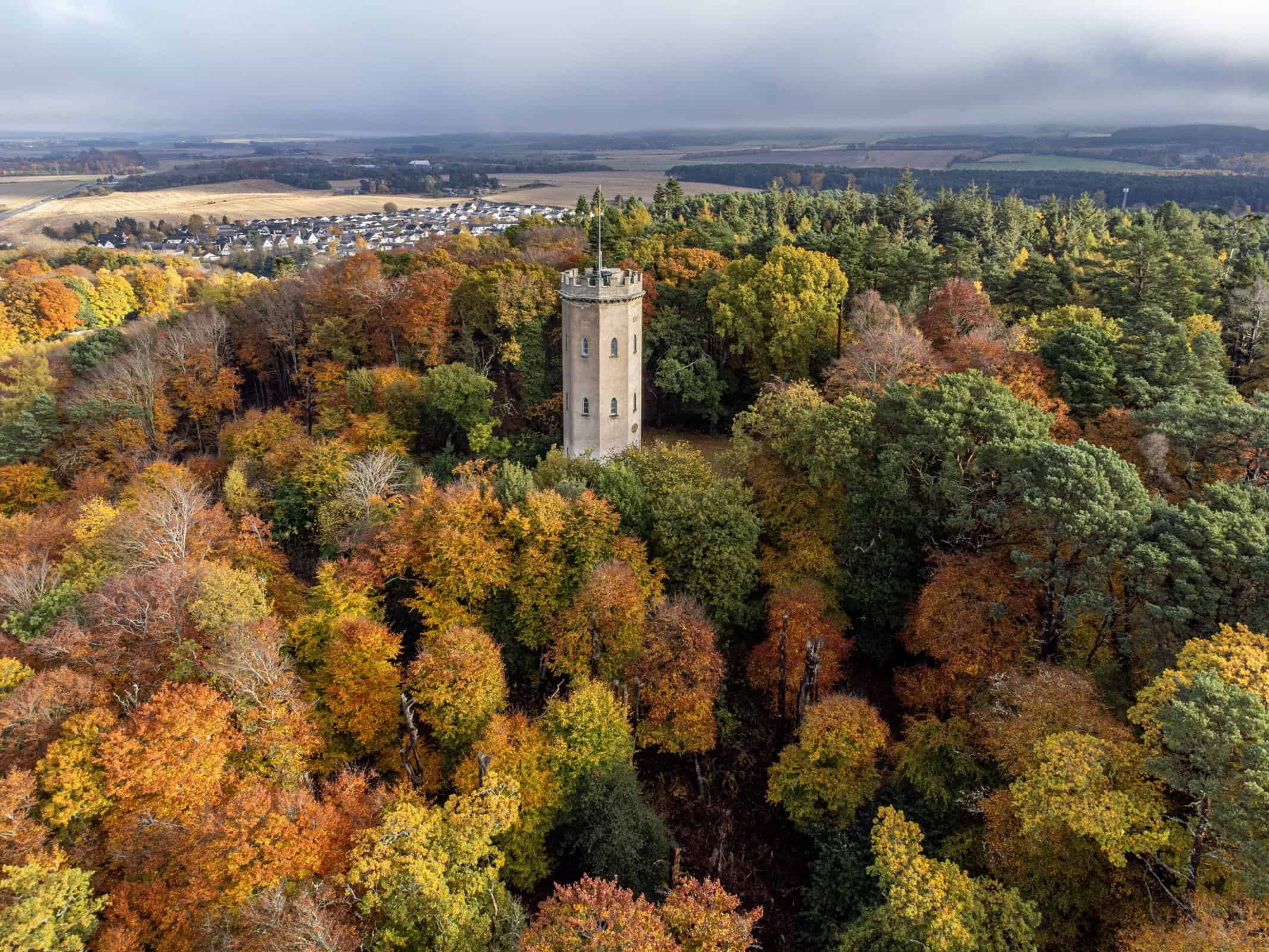
Make sure to put on sensible shoes for a trip up Cluny Hill. There is a bit of a climb involved, though nothing too arduous. Allow ten or fifteen minutes to make your way through the woods, past the lime trees and perhaps a red squirrel if you are so inclined. You will be rewarded at the summit with an octagonal tower of 21 metres in harled stone, all neo-Gothic swagger and what many would call the finest view in Moray. For more than two centuries it has lured people up here and it shows no signs of tiring of the task.
A local project
Many do not realise that the tower was paid for by public subscription from 270 individuals who between them put forward £610 – no trifling amount in the early 1800s. On 26 August 1806 James Brodie of Brodie laid the foundation stone, having first placed a few coins and a piece of parchment beneath it for posterity. The Forres Volunteers let off three volleys and the procession made its way back down for dinner. Very much in the Forres tradition to mark a naval victory and then have one’s tea.
Then there was the matter of the budget. Two more appeals for funds were called for in 1807 and 1810 before the work was done. When it finally opened on Trafalgar Day, 21 October 1812, it was a full seven years after the battle in question; a fair indication of the pace of things in Georgian Scotland. A 21-gun salute was fired by a pair of four-pounders said to have seen action at Alexandria, and they remain at the entrance to this day.
The subscribers were in such fine form they could not let the occasion go. The following year on the anniversary, a number of them established the Forres Trafalgar Club to raise a glass to Nelson at Maclean’s Inn and later in the tower. A wonderfully eccentric sort of history, a true gentlemen’s club with its own relics. Some of the odder pieces may be found at the Falconer Museum on Tolbooth Street (it’s currently closed in 2026, but plans are being made to re-open it soon).
After decades of looking after the tower, the Club ceded control to Forres Town Council in 1851, and later to Moray District Council in 1975. Now the Forres Heritage Trust is in charge, and when the tower is open you can see the Red Ensign on the mast.
Going further back in time
But don’t be fooled into thinking the tower is the oldest feature on the hill
In fact, Nelson’s Tower is something of a latecomer. Before the members of the Trafalgar Club were out with their silver cups, Cluny Hill had other uses entirely.
As far back as 1760 antiquarians were talking of an “old entrenchment”. The Bishop of Ossory, visiting Forres that year, saw a curious bank running round the hillside and attributed it to the Danes. A 1798 survey put the enclosure at over six acres and for a time it appeared on Ordnance maps as a fort, but the evidence was hard to come by.
Centuries of tree planting, not to mention a Victorian tower put on the summit, had reduced it to little more than a scarp in the ground.
Dr Leif Isaksen, a Forres man, put an end to the speculation in 2017. He and his team of archaeologists and volunteers held a community dig to coincide with the Piping at Forres event in Grant Park, allowing anyone to come and watch. They confirmed beyond doubt a hillfort dating from the Late Bronze to Early Iron Age, 800 to 350BC, unlike the open settlements more common in Moray.
They returned in 2018 to find ironworking slag near an old hearth, some 4th to 1st century BC. In short, there was iron being smelted on this spot well over two thousand years before anyone had the notion of building a tower in honour of a Georgian admiral.
The 2018 season of excavations yielded what may be a piece of a saddle quern, the kind of hand-worked stone one would have used to put grain to the mill. It is a modest find, but it says a lot: this was no mere defensive outpost, but a place where people made their home and went about the business of daily living.
From then on, the digs were something of an institution. They were put together as proper community archaeology with specialists from Forres and beyond in tow. One might find a curator from National Museums Scotland there for his knowledge of Iron Age ironworking, or prehistorians who had made their name at sites from Wiltshire to Munster.
For a fortnight the locals would put in time with trowel and mattock over ground that has confounded visitors since the 1700s. The results were duly recorded in Discovery and Excavation in Scotland and put into Canmore, the national record for historic sites in Scotland, putting Cluny Hill’s credentials in the archaeological record beyond any educated guesswork.
There is an old rumour to be put to rest too. Cluny Hill has been on the books as one of Scotland’s “vitrified forts” for decades, a term for ramparts thought to have been fused by fire in some ancient siege. A dramatic notion, but when the archaeologists set about finding hard proof of vitrification they found none. The idea is more a relic of antiquarian lists than of what is actually on the ground.
So forget the fiery last stand; this was simply a fortified hilltop where a community farmed and forged iron in peace, long before Trafalgar.
What lies ahead on the climb
Once at Nelson’s Tower, you will encounter four levels in all, roof included, linked by a central spiral staircase of some 96 steps. It can be steep, but there are rest stops here and there with exhibition rooms at each level to provide a fitting pretext for catching one’s breath.
At the top a volunteer is generally on hand with binoculars and a store of local colour to tell you what you are seeing. And it is worth the effort: the Moray coast running out to Burghead and Nairn, Findhorn Bay below, and on a good day the hazy outline of Caithness hills on the horizon. Face inland and the Cairngorms and Speyside hold up the skyline. Should the haar come in off the North Sea, the town can disappear under a sea fog while you are left in the sun above it, making for a moody photograph you will want to keep.
Uphill
The Red Ensign will tell you if the tower is open; it is so from April through September, every day between 2pm and 4pm. There is no charge, just a donation. You can make your way up from Grant Park via the lime tree avenue starting on on South Street or the car park at the east end. The path is well made and gentle enough, though it is unrelentingly uphill.
In the off season the tower is locked but one can still make the walk up Cluny Hill. The view from the base is a fine consolation and the woodland is pleasant in any month.
Why go
It remains the finest photo opportunity for miles. There is a certain appeal in a landmark raised by the townsfolk and not by government or crown. But then again, the hill was always going to be climbed. An Iron Age community once stood right where you are, with the same vantage over the Moray Firth they have enjoyed for two and a half thousand years.
Once you have the whole of Moray spread out before you with Findhorn Bay in the distance, you will see why they made their mark here, and you will likely want an excuse to come back and do the same in all the seasons.