
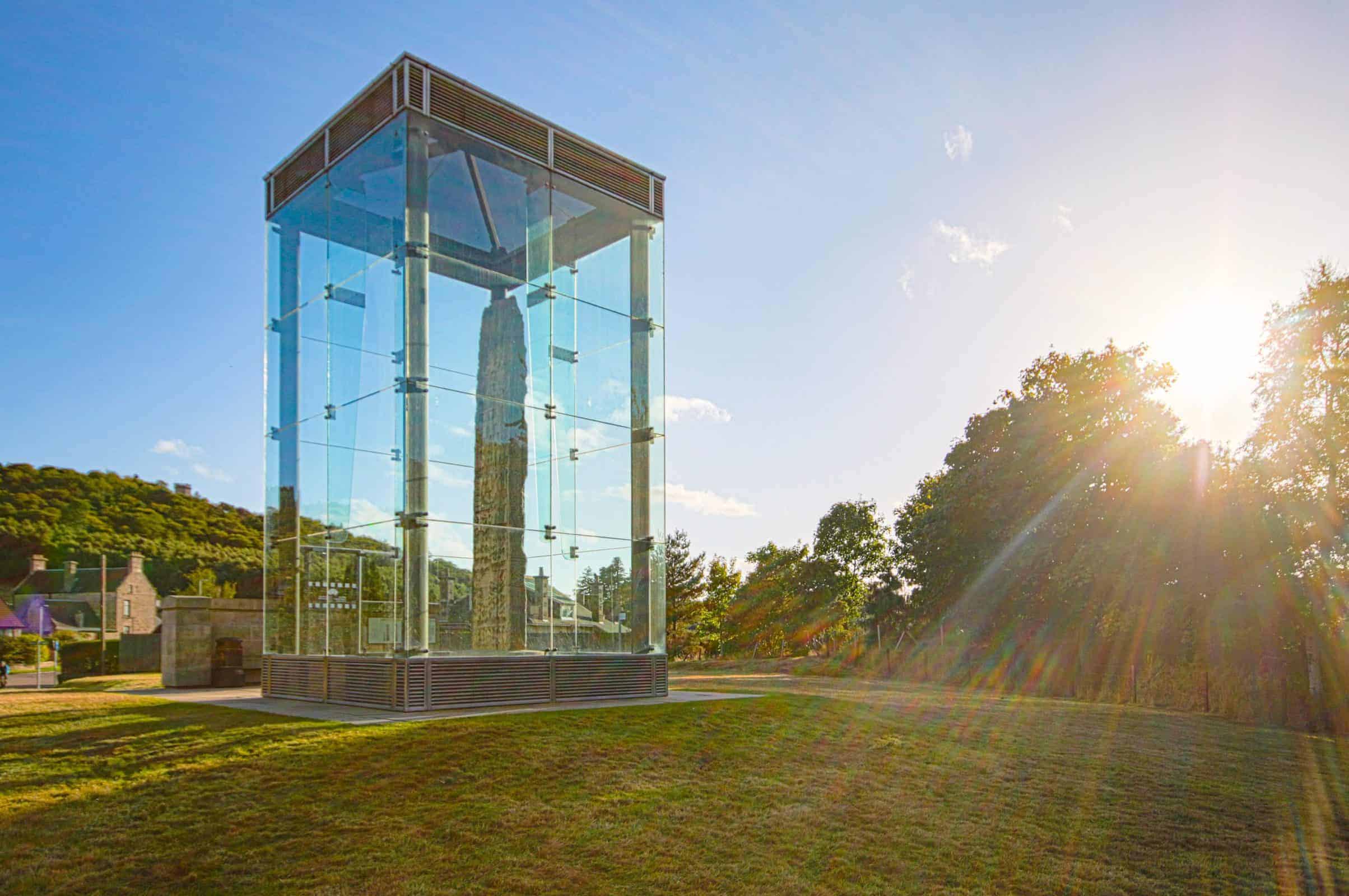
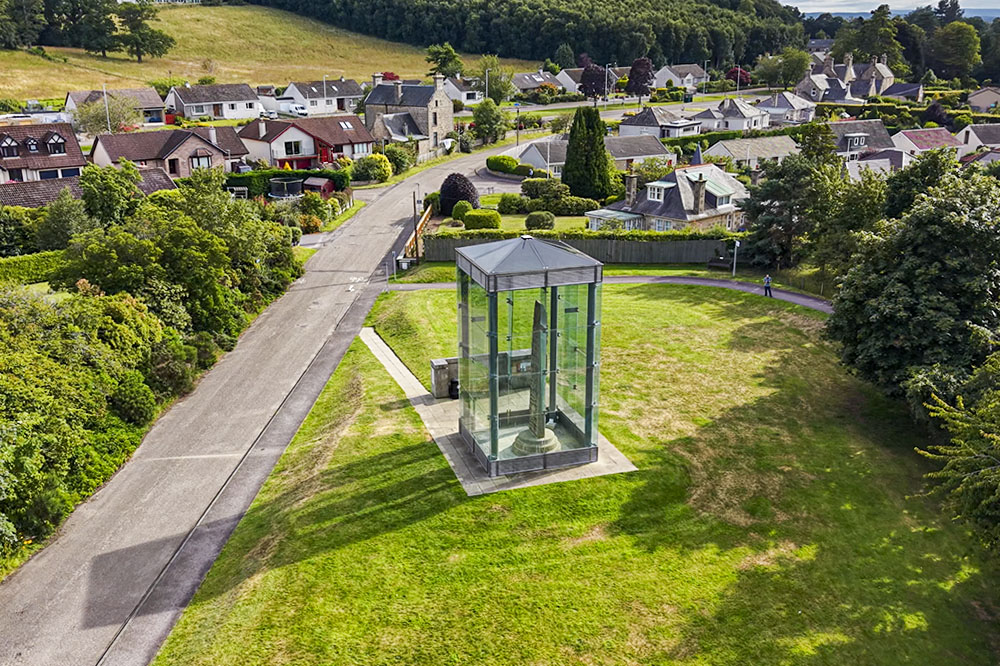
You might just miss it if you are driving into Forres from the east. There on the roundabout’s edge, behind a shroud of glass and letting the traffic whizz by to the shops, is a fine slab of grey sandstone. At over six metres high, it is older than most things left standing in Moray and taller than your average house.
Most will give it a cursory few minutes and take a picture through the glass. The locals have long since stopped looking at it twice, which is a shame. Sueno’s Stone is perhaps the odder thing in all of IV36 and warrants some time spent before you head into town.
The stone itself
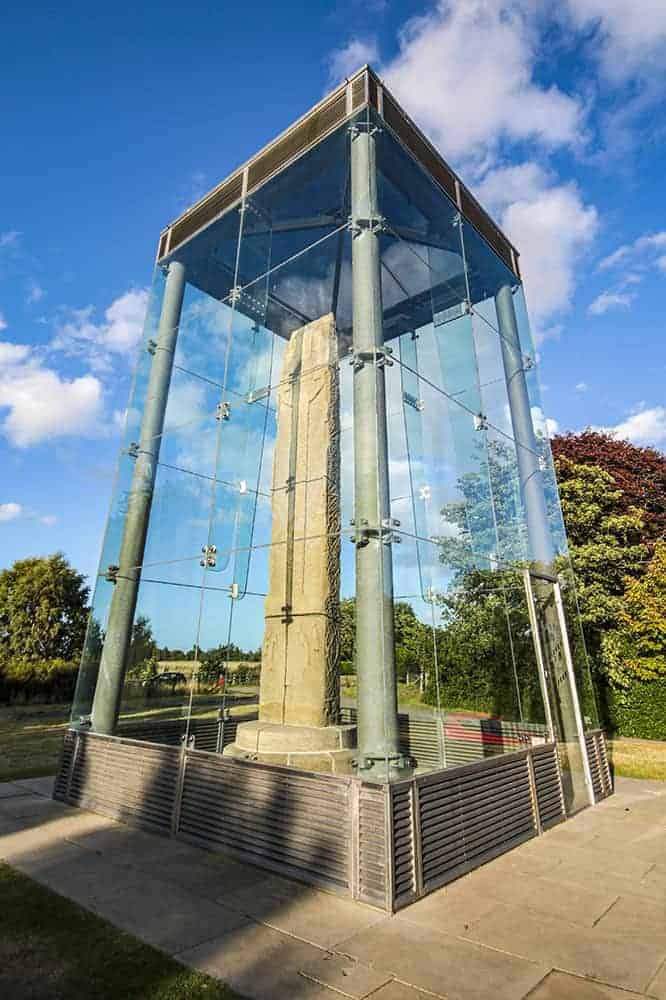
Technically a Pictish cross-slab of the 9th or 10th century, but that doesn’t do it justice. It has two sides that are at odds with one another. You have an ornate cross on one face, full of knotwork and the like, the sort of pious work a monk would put his time into. Turn around and there is a battle scene. Soldiers, cavalry, a tangle of fighters and, at the foot of it, a grim stack of headless corpses as neat as firewood.
Don’t think of it as mere decoration. It is a report filed in rock. Someone wanted the details of this remembered, down to the gruesomeness. A shrewd move on the part of the Picts, because we are still here a millennium on and they have us arguing about it.
Putting two and two together
The prevailing view is that it is a marker for some hard-fought affair, maybe the violent demise of a Pictish kingdom at the hands of the new Scotland or Norsemen coming down from the north. Forres was on the fault line then as now, so a monument to a bloody change of guard fits.
You will hear scholars put it down to the death of King Dubh in 966, or go back to the 840s and the campaigns of Kenneth MacAlpin. Equally likely, and equally unprovable; the stone has the receipts but no caption to speak of.
And don’t be surprised if someone tries to make a case for Macbeth. Anything with age and drama in this town gets sucked into his orbit. Given he hails from right here in Moray and not some vague Shakespearean idea of Scotland, you can see why. But there is nothing to link him to this stone in particular. We are only human after all, and the story is too tempting.
The unknowns
If we are frank, we have very little else to go on. Who put the chisel to it? Who put up the money? Why the two faces seem to have been done in different moods? One could argue it has been moved about over the years like a large garden ornament, though it is hard to tell.
It is unusual for a piece of work this size and detail to hold on to its secrets. Historians have usually picked such things to pieces until there is no mystery left. Not so with Sueno’s Stone. It sits there and dares you to make something of it.
Make the detour
A photograph won’t convey the scale. You have to stand beside it to be properly dwarfed by it, and to put in mind that it was old hat long before Kinloss Abbey was more than a drawing on parchment. When you look at the battle side, it ceases to be a pattern and you see the rider going down, the figures under the tent, and the row along the bottom that is best not examined too closely.
It is free, sheltered and a two-minute walk from the centre, open come rain or shine — although a moody sky is the way to appreciate it, and as we know, that is the norm in Moray.
Park up and have your five minutes with it. Then make your way to the High Street for a coffee and to see what the flower baskets on the lampposts are up to. Once you have had your fill of the stone, you may as well put in an appearance for dinner. There is always an excuse to make an evening of it.
For additional research, read this excellent in-depth article from local historian Ray Mills from the Forres Heritage Trust: The Stone oif Forres, also known as Sueno’s Stone.
Directions: An easy stop on the B9011 as you come in off the A96 from Elgin or Nairn, or en route to Findhorn and Kinloss. See map below.
Picture credits: Marc Hindley