

There is a certain singularity to Dallas Dhu in the Scottish whisky scene. One would be hard pressed to find another distillery quite like it, not because of what it produces, but for the way it is poised between the present and bygone days.

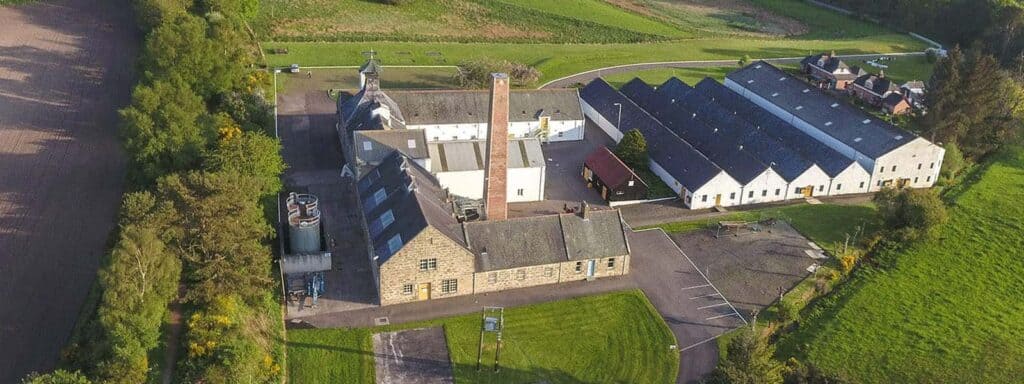

Those with an appreciation for history will find more here than the usual tasting room or the trappings of a modern visitor centre. What is on offer is an industrial world left intact, a genuine piece of the era when the Speyside boom was fuelled by coal smoke and the long hours of distillers whose work predated the convenience of automation.
But the story of Dallas Dhu is changing. The last barrel was filled in 1983, after which it closed. Laster, Historic Scotland opened it as a museum of distilling, which is why the machinery has been left as an exhibition of distilling history.
Now, Historic Environment Scotland and Aceo Spirits are working together to reopen the historic distillery, restart whisky production and turn it into a state-of-the-art visitor attraction.
The site is to be found just a couple of miles outside Forres.
More to dhu?
Originally named Dallasmore before taking its current name in the 20th century, it was never one of the giant names of Speyside. Its working life was of a modest sort, which is no small part of its appeal. It was not some sprawling complex but a compact and unpretentious whisky works where the production process was easy to read.
In that lies the draw of Dallas Dhu. Where many tours have become polished, even theatrical, affairs with their digital projections and premium lounges, this is different. There is no attempt at modern luxury, only heritage.
From the old mash tun and washbacks to the still house and kiln, the traditional layout speaks to the logic of the late Victorian and early 20th century. A guest does not just look on from afar but makes his way through the rooms, almost as if on an archaeological dig. One comes to understand how the distillery set the rhythm of rural Scotland.
This has a particular resonance in Speyside. The region’s whisky industry is vast, with all the brand recognition and commercial might that entails, and its reach goes well beyond Moray. But the scale of the modern operation can serve to obscure the human element at its roots.
Perspective
Dallas Dhu puts that back into perspective. It is a reminder that today’s global standing was built on local know-how and practical skill in much smaller operations. In a way, it is a necessary corrective to the view of whisky as nothing more than contemporary branding. For anyone on the Malt Whisky Trail, it is a stop well worth the time. Any number of enthusiasts will be drawn to the trail for its showcase of the region’s distilling heritage and some of Scotland’s more notable whisky sites. But where most make for the working distilleries and their tastings, Dallas Dhu provides a necessary historical counterweight to the route, one that puts the rest of the trail in perspective. Having been to a modern operation, a visit here is instructive; it tells you what has withstood the test of time and what was once standard procedure, and what has given way to change. In doing so, it gives the long view, tempering the appeal of whisky tourism with the realities of older production and the way things were for an earlier generation of distillers.
Then there is the matter of place. Situated in IV36, Dallas Dhu is woven into a wider local narrative. Forres and the district have two other distilleries in the same postcode, creating a tight cluster of heritage. That is no small thing; it underlines the fact that Dallas Dhu is not some isolated oddity but part of a living geography, reflective of an industrial and cultural ecology in which whisky has been inextricably linked to trade, agriculture and employment for as long as anyone can remember. And yet its position in that group is singular by virtue of the fact that it does not produce. While the others are adding to the region’s current output, Dallas Dhu offers memory and interpretation.
Many are taken aback by the emotional pull of the site. An inactive distillery is more contemplative than spectacular. You can go into rooms that would have been all noise, heat and labour and find only stillness. The quiet is as much a feature as the building itself, letting the mind fill in the blanks: the steam from the still house, the barley, the comings and goings of the workers, the business of fire and water. A working distillery will put these before you as part of the day’s process; at Dallas Dhu they are conjured by their very absence, lending a certain poignancy to the experience.
For those with an eye for history, this is invaluable. It is an interpretive site, not just an old distillery in a pretty spot, and it shows the technical and social side of production in a manner a well-appointed modern facility might not. It is tied to the Speyside industry and speaks to the continuity of the region, even if the economy has evolved and the prestige of the area has grown.
In the end, Dallas Dhu is a place of remembrance rather than output. It stands in quiet opposition to the pace of the modern whisky world and presents itself as a preserved environment, not a commercial concern. Whether one is on the Malt Whisky Trail or in IV36 looking for a fuller picture of Speyside’s past, it is a stop worth making. It is a distillery that has ceased to be, and in that has conserved something of real value.