
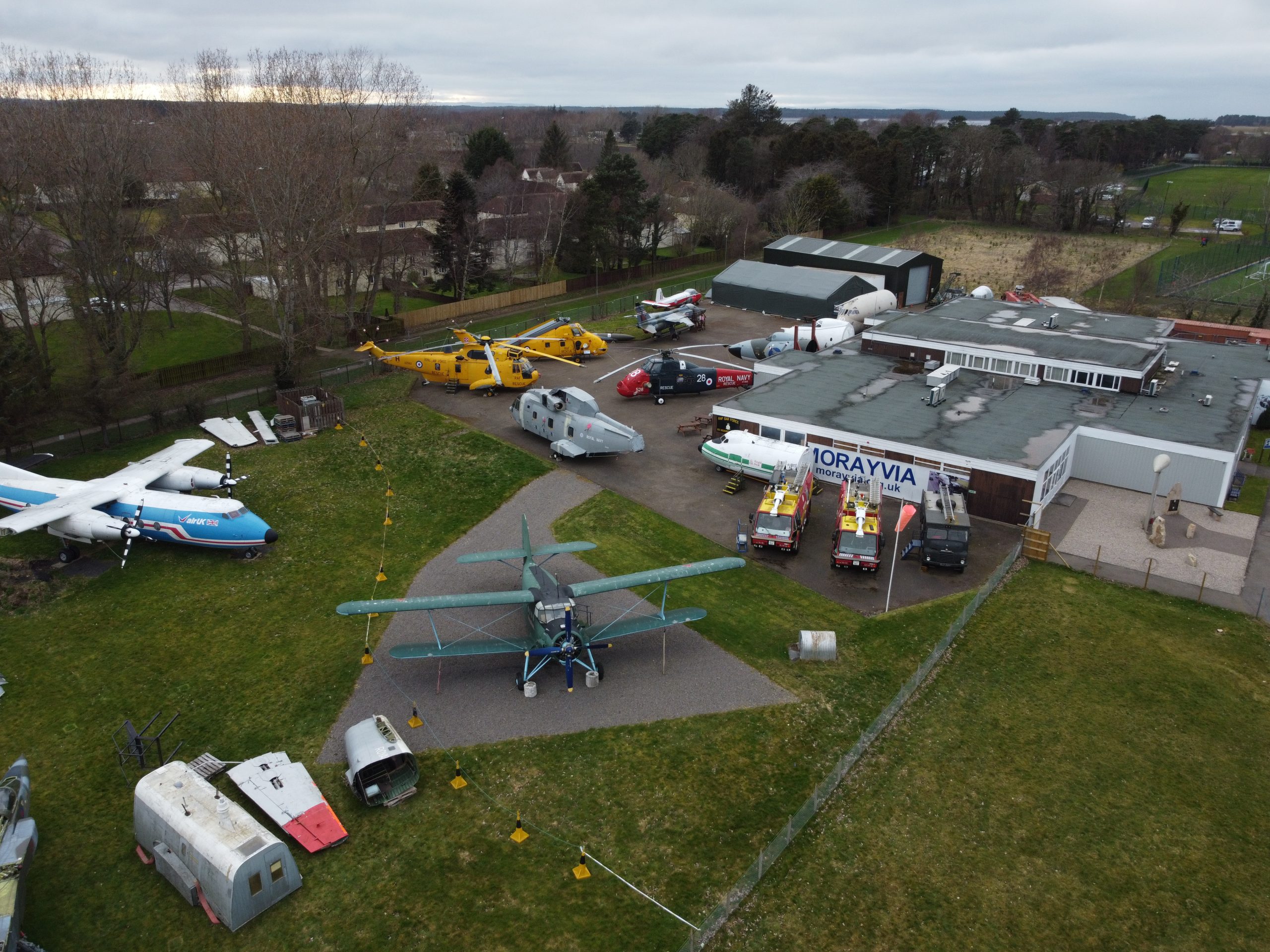
There are not many places in Scotland with the quiet pull of RAF Kinloss for those with an interest in military history or aviation. Situated on the Moray coast, the former Royal Air Force station was once central to maritime patrol and the kind of vigilance that defined the Cold War, all under the watchful eye of the Avro Nimrod. The operational days at Kinloss are for the most part a thing of the past, but one would be wrong to think the legacy has gone with them. In large measure it has been given new life by a volunteer institution of some note: Morayvia.


RAF Kinloss and its maritime roots
The base dates back to the Second World War, yet it was in the postwar years that RAF Kinloss truly made its name in the field of maritime patrol aviation. With the Cold War in full swing and Soviet naval activity in the North Atlantic a matter of constant concern, the station took on a strategic importance as one of the RAF’s main outposts for such work. Here they put to use the Nimrod, an aircraft purpose-built from the de Havilland Comet airliner.
One cannot speak of the Nimrod without acknowledging what it was: an aircraft of considerable range and sophistication, if not commercial glamour. It was an indispensable machine for anti-submarine warfare and surveillance, packed with the necessary sensors and weaponry to handle an increasingly complicated geopolitical scene. For the men who served with it, the Nimrod was a fine example of engineering and no-nonsense operation alike. For decades the very identity of Kinloss was bound up with the unmistakable rumble of the type on approach. So when the RAF began to wind down its maritime patrol force and retire the planes, it was a keenly felt moment for both the personnel and the community.
The last Nimrod to leave Kinloss
To call it “the last Nimrod to leave Kinloss” is to give the phrase more than its logistical meaning. It was a ceremonial end to the station’s long association with an aircraft that had come to define much of its modern era, a move from active duty to heritage.
Some might have let the final machine be written off or dispersed, but there were local supporters and preservationists who would have none of it. They saw in the aircraft something worth saving, not as a mere exhibit but as a way to tell the story of the aircrew, the maintenance culture and the social fabric of the military community here. This particular plane was the physical embodiment of a time when Britain’s reconnaissance reach extended far across the Atlantic. Its path from service to museum is a testament to a community’s resolve not to let a piece of national and local history fade away.


Morayvia: the volunteer way
That is where you find Morayvia. It does not have the deep pockets of a major state-run national museum, and its appeal is in its grassroots nature. Put together by the efforts of enthusiasts and volunteers, the museum has become the place to go for the region’s aerospace and defence heritage, particularly anything with ties to the RAF in Moray.
Such is the lot of the volunteer-run museum in the heritage world; with lean staff and tight budgets, they face their share of practical challenges, but they fill a niche that is hard to replicate. There is an extraordinary effectiveness to what they do, born of a mission that is in many ways deeply personal. One would be hard pressed to call it abstract stewardship; more often it is an act of devotion. In the cleaning of a panel, the interpretation of a display or the preservation of a single bolt, there is a historical argument being made: these are stories that must be allowed to survive.
Take Morayvia’s handling of the Nimrod for instance. It is no small achievement to have moved, housed and put before the public such a large military aircraft on volunteer labor alone. The work is formidable. The plane has to be stabilized and shielded from the elements, then made to make sense to a visitor who may only have a vague idea of its past.
Why the Nimrod matters
In technical circles the Nimrod is usually talked about in programmatic terms, with reference to the difficulties of its modernisation. But heritage value is not a matter of technological success or failure. The Nimrod is important because at a certain point in strategic history it was called upon for a demanding job. As part of Britain’s maritime shield it was a machine built for endurance and vigilance, not for show or speed.
To the student of military history the aircraft is also indicative of a wider change, from the certainties of the Cold War to the ambiguity that followed, and from old-fashioned patrol work to the electronics of high-tech surveillance. It is a symbol of both continuity and change. While the public may remember the airframe as one of obsolescence and modernisation headaches, in preservation it is given back its nuance.
At Morayvia the Nimrod is more than an artifact set apart from its context; it is a means of instruction. A visitor is left to consider what the purpose of maritime patrol aviation was and what was forfeited when the RAF put the type out to pasture. The museum is preserving institutional memory, not just metal and rivets.
A local story with national significance
The appeal of the Kinloss-Morayvia narrative lies in its scale. On one hand it is local and intimate, tied to a region and the people of a particular station, but the implications are national. What happens to the last Nimrod from Kinloss is in some ways a test case for how we deal with modern military heritage once an aircraft is out of service.
Preservation is a matter of luck and advocacy as much as anything; too many a historically significant machine is broken up or put in storage for good. Here, local resolve has seen to it that a bit of RAF history remains in good enough order to tell its tale. For the historian it is an anchor for debate on maritime defence and the material culture of service life. For the aviation enthusiast it is a direct line to an operational past. And for the local historian it underlines the way a base can define a place long after the runway has gone quiet.
Where history lands
It is apt that aviation history should come to rest at Morayvia. An aircraft is designed to fly and serve and, in time, to stop. Then one has to decide if it will simply vanish or become a witness. The last of the Kinloss Nimrods was fortunate in finding a home with those who get what it is all about.
Morayvia sees to it that the story does not conclude with retirement. Through education and care it goes on. You might say it is a quieter form of remembrance than the iconic bombers and fighters that tend to dominate the heritage scene, but no less vital. The Nimrod is done with the sky, but at Kinloss and Morayvia its legacy still has altitude.